Eroded mortar joints, loose parapets, cracked chimney crowns and rusting lintels, handled as one managed job: we scope it, permit it and run it, and experienced partner masons do the brickwork.
We are a roofing company, and we say so. Masonry and roofing meet at the places that leak, chimneys and parapets, which is why homeowners and boards ask us to take the whole thing on.
Inspect the wall, chimney or parapet and find where the water is really getting in, which is often the flashing rather than the brick. Write one scope and one estimate. Pull the permit. Schedule the mason and coordinate the work with any roof work. Handle all flashing and roof tie-ins ourselves. Close it out with one invoice.
The masonry itself: grinding or raking out joints and repointing them, replacing damaged brick, rebuilding parapets, chimney crowns and sections of wall, and lintel work. Inside the City of Chicago the mason of record holds a City mason license, as the City requires.
Tuckpointing, also called repointing, is removing deteriorated mortar from the joints to a consistent depth and packing in new mortar. It is the right repair when the brick itself is sound and the mortar has eroded, cracked or washed out, which freeze-thaw cycles do to every older wall in this climate. Recessed joints, sandy mortar you can scrape with a key, and gaps you can see light through are the usual signs.
Done properly, it preserves the wall rather than replacing it. The joint has to be cut back deep enough, usually around two to two and a half times the joint width, so the new mortar locks in rather than sitting on the surface.
Repointing a wall whose bricks are failing only buys a few seasons. These are the conditions that call for rebuilding a section instead. The longer comparison is in our tuckpointing vs rebuilding guide.
Brick faces that have flaked off, often from water trapped behind a too-hard mortar, have to be cut out and replaced with brick that matches in size, color and hardness.
Parapets take weather on both faces and the top. Once the brick has moved, repointing will not hold it; the section is taken down and rebuilt, usually with new coping and through-wall flashing, which ties into the roof.
A cracked crown lets water straight into the chimney. Crowns are rebuilt with a proper overhang so water drips clear of the brick, and the top courses often go with them.
Steel over windows and doors rusts and expands, cracking the brick above in a stair-step pattern. The fix is replacing or treating the lintel and relaying the brick around it, not filling the crack.
A wall that has moved out of plane is a structural question first. We bring in the right people to assess it before anyone touches the mortar.
Much of the housing around Chicago, from bungalows to two-flats to older suburban homes, is built in soft common brick. The mortar in those walls is meant to be softer than the brick, so that movement and moisture work on the joint, which can be repointed, rather than on the brick, which cannot. A modern hard, cement-rich mortar reverses that: the brick cracks and spalls while the joint stays perfectly intact. Our masons match the mortar's strength, color and texture to the wall. The details are in lime vs Portland mortar on old Chicago brick.
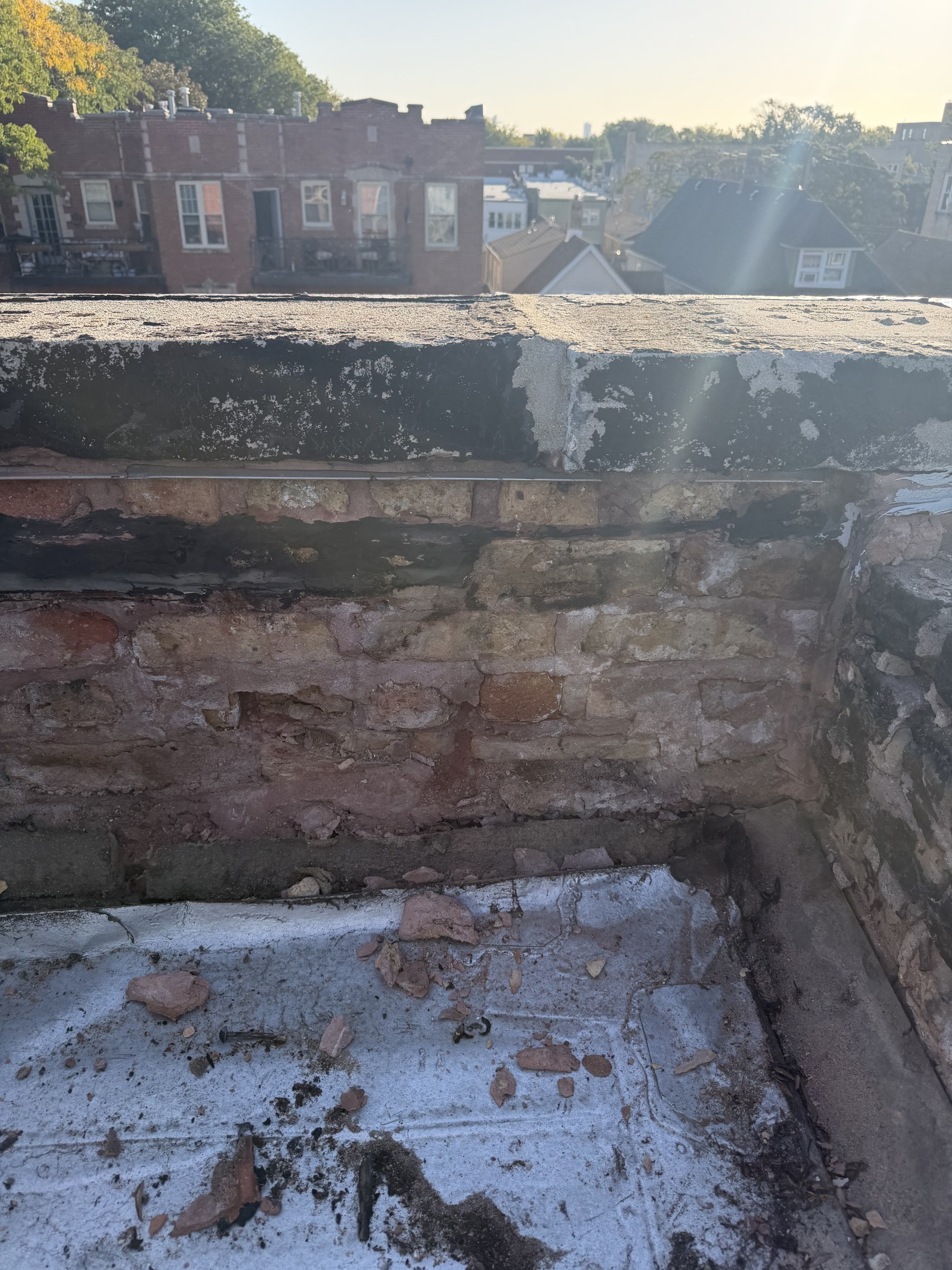
Alongside a low-slope roof recover on a twelve-unit building, the association asked us to take on its masonry too. The limestone parapet at the firewall was ground out and repointed, and because the parapet brick is old odd-sized Chicago common, matching replacement brick was sourced as its own line item. The chimney masonry was done in the same project. Permitted, inspected, and closed out with one invoice for the board. The photo is the parapet before the work. More on our Our Work page.
We do not publish a per-square-foot price, because the same square footage can be very different jobs. The things that move the number: how much wall or how many linear feet of joint need work and how deep the erosion goes; height and access, from ladders to scaffold to a lift; how many bricks need replacing and whether matching old brick has to be sourced; mortar color and type matching; lintel, crown or parapet rebuilding; the permit; and the season. Every estimate itemizes them.
Permits: inside the City of Chicago, masonry repair generally needs a City permit and a City-licensed mason, which we arrange as general contractor. Suburban villages set their own rules, and we check with the village on every job.
Where we work: the north and northwest suburbs across Cook, Lake and DuPage counties, and in the city, the Far Northwest Side. Residential and commercial, including condominium associations and property managers. For chimney leaks specifically, start with our chimney and masonry repair page: the leak is often the flashing, not the brick.
It depends on the job more than on any per-square-foot figure, which is why we do not publish one. What moves the price: how much wall needs repointing and how deep the mortar has eroded, the height and access (ladders, scaffold or a lift), how many bricks need replacing and whether matching old brick has to be sourced, mortar color and type matching, any lintel or parapet rebuilding, and the permit. We give you a written, itemized estimate after looking at the wall.
Masonry repair inside the City of Chicago generally needs a City permit, and the masonry has to be done by a City-licensed mason. We handle the permit as the general contractor and use a licensed mason of record. Suburban villages set their own rules; some require a permit for masonry repair and some do not, and we check with the village on every job.
Small areas, possibly, if you are comfortable on a ladder and match the mortar properly. The two common DIY mistakes do lasting damage: using a modern hard mortar on old soft brick, which makes the brick crack and spall instead of the joint, and smearing new mortar over joints that were not ground out deep enough, which falls out within a few winters. Anything high, on a chimney or on a parapet is a job for a mason.
Because almost all of it is skilled labor. Every joint has to be ground or raked out to a consistent depth, cleaned, and packed in layers by hand, and on a two-story wall or a chimney the access equipment is a real cost too. Done properly it lasts decades; done cheaply it fails in a few years and gets paid for twice.
No. Our crews are roofers. We inspect, find where the water is actually getting in, write the scope, pull the permit, schedule the work and manage it, and experienced partner masons do the grinding, repointing and brickwork. You get one estimate, one point of contact and one invoice. When the masonry ties into the roof, as it does at chimneys and parapets, the flashing side is ours.
Properly done with a compatible mortar, repointed joints commonly last 25 years or more. The exposed places, chimneys and parapets, wear first because they take weather from every side.
Mortar needs temperatures above freezing to cure, so the normal season runs from spring through fall. Late fall and winter work is possible only with protection and the right conditions; we schedule around the weather rather than risk joints that never cured properly.
Yes. Parapets, firewalls and chimneys on condominium buildings, two-flats and commercial buildings are common work, and they often go together with a roof project. We work with boards and property managers on the scope, the permit and the schedule.
One written estimate for the masonry and anything it touches on the roof. Call (708) 847-5418 or fill out the form.